

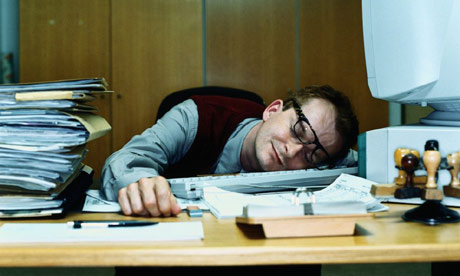
when you’re dead, realize that you’re making a
decision that can make that day come much
sooner. Pushing late into the night is a health and
productivity killer.
According to the Division of Sleep Medicine at the
Harvard Medical School, the short-term
productivity gains from skipping sleep to work are
quickly washed away by the detrimental effects of
sleep deprivation on your mood, ability to focus,
and access to higher-level brain functions for days
to come. The negative effects of sleep deprivation
are so great that people who are drunk
outperform those lacking sleep.
Why You Need Adequate Sleep to Perform
We’ve always known that sleep is good for your
brain, but new research from the University of
Rochester provides the first direct evidence for
why your brain cells need you to sleep (and sleep
the right way—more on that later). The study
found that when you sleep your brain removes
toxic proteins from its neurons that are by-
products of neural activity when you’re awake.
Unfortunately, your brain can remove them
adequately only while you’re asleep. So when you
don’t get enough sleep, the toxic proteins remain
in your brain cells, wreaking havoc by impairing
your ability to think—something no amount of
caffeine can fix.
Skipping sleep impairs your brain function across
the board. It slows your ability to process
information and problem solve, kills your
creativity, and catapults your stress levels and
emotional reactivity.
What Sleep Deprivation Does to Your Health
Sleep deprivation is linked to a variety of serious
health problems, including heart attack, stroke,
type 2 diabetes, and obesity. It stresses you out
because your body overproduces the stress
hormone cortisol when it’s sleep deprived. While
excess cortisol has a host of negative health
effects that come from the havoc it wreaks on
your immune system, it also makes you look
older, because cortisol breaks down skin collagen,
the protein that keeps skin smooth and elastic. In
men specifically, not sleeping enough reduces
testosterone levels and lowers sperm count.
Too many studies to list have shown that people
who get enough sleep live longer, healthier lives,
but I understand that sometimes this isn’t
motivation enough. So consider this—not
sleeping enough makes you fat. Sleep deprivation
compromises your body’s ability to metabolize
carbohydrates and control food intake. When you
sleep less you eat more and have more difficulty
burning the calories you consume. Sleep
deprivation makes you hungrier by increasing the
appetite-stimulating hormone ghrelin and makes
it harder for you to get full by reducing levels of
the satiety-inducing hormone leptin. People who
sleep less than 6 hours a night are 30% more
likely to become obese than those who sleep 7 to
9 hours a night.
How Much Sleep Is Enough?
Most people need 7 to 9 hours of sleep a night to
feel sufficiently rested. Few people are at their
best with less than 7 hours, and few require more
than 9 without an underlying health condition.
And that’s a major problem, since more than half
of Americans get less than the necessary 7 hours
of sleep each night, according to the National
Sleep Foundation.
For go-getters, it’s even worse.
A recent survey of Inc. 500 CEOs found that half
of them are sleeping less than 6 hours a night.
And the problem doesn’t stop at the top.
According to the Centers for Disease Control and
Prevention, a third of U.S. workers get less than 6
hours of sleep each night, and sleep deprivation
costs U.S. businesses more than $63 billion
annually in lost productivity.
Doing Something About It
Beyond the obvious sleep benefits of thinking
clearly and staying healthy, the ability to manage
your emotions and remain calm under pressure
has a direct link to your performance.
TalentSmart has conducted research with more
than a million people, and we’ve found that 90%
of top performers are high in emotional
intelligence (EQ). These individuals are skilled at
understanding and using emotions to their
benefit, and good sleep hygiene is one of the
greatest tools at their disposal.
High-EQ individuals know it’s not just how much
you sleep that matters, but also how you sleep.
When life gets in the way of getting the amount of
sleep you need, it’s absolutely essential that you
increase the quality of your sleep through good
sleep hygiene. There are many hidden killers of
quality sleep. The 10 strategies that follow will
help you identify these killers and clean up your
sleep hygiene. Follow them, and you’ll reap the
performance and health benefits that come with
getting the right quantity and quality of sleep.
1. Stay Away from Sleeping Pills: When I say
sleeping pills, I mean anything you take that
sedates you so that you can sleep. Whether it’s
alcohol, Nyquil, Benadryl, Valium, Ambien, or
what have you, these substances greatly disrupt
your brain’s natural sleep process. Have you ever
noticed that sedatives can give you some really
strange dreams? As you sleep and your brain
removes harmful toxins, it cycles through an
elaborate series of stages, at times shuffling
through the day’s memories and storing or
discarding them (which causes dreams). Sedation
interferes with these cycles, altering the brain’s
natural process.
Anything that interferes with the brain’s natural
sleep process has dire consequences for the
quality of your sleep. Many of the strategies that
follow eliminate factors that disrupt this recovery
process. If getting off sleeping pills proves
difficult, make certain you try some of the other
strategies (such as cutting down on caffeine) that
will make it easier for you to fall asleep naturally
and reduce your dependence upon sedatives.
2. Stop Drinking Caffeine (at Least after Lunch):
You can sleep more and vastly improve the
quality of the sleep you get by reducing your
caffeine intake. Caffeine is a powerful stimulant
that interferes with sleep by increasing adrenaline
production and blocking sleep-inducing chemicals
in the brain. Caffeine has a 6-hour half-life, which
means it takes a full 24 hours to work its way out
of your system. Have a cup of joe at 8 a.m., and
you’ll still have 25% of the caffeine in your body
at 8 p.m. Anything you drink after noon will still be
near 50% strength at bedtime. Any caffeine in
your bloodstream—the negative effects
increasing with the dose—makes it harder to fall
and stay asleep.
When you do finally fall asleep, the worst is yet to
come. Caffeine disrupts the quality of your sleep
by reducing rapid eye movement (REM) sleep, the
deep sleep when your body recuperates most.
When caffeine disrupts your sleep, you wake up
the next day with a cognitive and emotional
handicap. You’ll be naturally inclined to grab a
cup of coffee or an energy drink to try to make
yourself feel more alert, which very quickly
creates a vicious cycle.
3. Avoid Blue Light at Night: This is a big one—
most people don’t even realize it impacts their
sleep. Short-wavelength blue light plays an
important role in your mood, energy level, and
sleep quality. In the morning, sunlight contains
high concentrations of this “blue” light. When your
eyes are exposed to it directly (not through a
window or while wearing sunglasses), the blue
light halts production of the sleep-inducing
hormone melatonin and makes you feel more
alert. This is great, and exposure to a.m. sunlight
can improve your mood and energy levels. If the
sun isn’t an option for you, try a blue light device.
In the afternoon, the sun’s rays lose their blue
light, which allows your body to produce
melatonin and start making you sleepy. By the
evening, your brain does not expect any blue light
exposure and is very sensitive to it. The problem
this creates for sleep is that most of our favorite
evening devices—laptops, tablets, televisions, and
mobile phones—emit short-wavelength blue light.
And in the case of your laptop, tablet, and phone,
they do so brightly and right in your face. This
exposure impairs melatonin production and
interferes with your ability to fall asleep as well as
with the quality of your sleep once you do nod
off. Remember, the sleep cycle is a daylong
process for your brain. When you confuse your
brain by exposing it in the evening to what it
thinks is a.m. sunlight, this derails the entire
process with effects that linger long after you
power down. The best thing you can do is avoid
these devices after dinner (television is okay for
most people as long as they sit far enough away
from the set). If you must use one of these
devices in the evening, you can limit your
exposure with a filter or protective eye wear.
4. Wake Up at the Same Time Every Day:
Consistency is key to a good night’s sleep,
especially when it comes to waking up. Waking up
at the same time every day improves your mood
and sleep quality by regulating your circadian
rhythm. When you have a consistent wake-up
time, your brain acclimates to this and moves
through the sleep cycle in preparation for you to
feel rested and alert at your wake-up time.
Roughly an hour before you wake, hormone
levels increase gradually (along with your body
temperature and blood pressure), causing you to
become more alert. This is why you’ll often find
yourself waking up right before your alarm goes
off.
When you don’t wake up at the same time every
day, your brain doesn’t know when to complete
the sleep process and when it should prepare you
to be awake. Long ago, sunlight ensured a
consistent wake-up time. These days, an alarm is
the only way most people can pull this off, and
doing this successfully requires resisting the
temptation to sleep in when you’re feeling tired
because you know you’ll actually feel better by
keeping your wake-up time in tact.
5. No Binge Sleeping (In) on the Weekend:
Sleeping in on the weekend is a
counterproductive way to catch up on your sleep.
It messes with your circadian rhythm by giving
you an inconsistent wake-up time. When you
wake up at the same time during the work week
but sleep past this time on the weekend, you end
up feeling groggy and tired because your brain
hasn’t prepared your body to be awake. This isn’t
a big deal on your day off, but it makes you less
productive on Monday because it throws your
cycle off and makes it hard to get going again on
your regular schedule.
6. Learn How Much Sleep You Really Need: The
amount of sleep you need is something that you
can’t control, and scientists are beginning to
discover the genes that dictate it. The problem is,
most people sleep much less than they really
need and are under-performing because they
think they’re getting enough. Some discover this
the hard way. Ariana Huffington was one of those
frantic types who underslept and overworked,
until she collapsed unexpectedly from exhaustion
one afternoon. She credits her success and well-
being since then to the changes she’s made to her
sleep habits. “I began getting 30 minutes more
sleep a night, until gradually I got to 7 to 8 hours.
The result has been transformational,” Huffington
says, adding that, “all the science now
demonstrates unequivocally that when we get
enough sleep, everything is better: our health; our
mental capacity and clarity; our joy at life; and our
ability to live life without reacting to every bad
thing that happens.”
Huffington isn’t the only one. Jeff Bezos, Warren
Buffet, and Sheryl Sandberg have all touted the
virtues of getting enough sleep. Even Bill Gates, an
infamous night owl, has affirmed the benefits of
figuring out how much sleep you really need: “I
like to get 7 hours of sleep a night because that’s
what I need to stay sharp and creative and
upbeat.” It’s time to bite the bullet and start going
to bed earlier until you find the magic number
that enables you to perform at your best.
7. Stop Working: When you work in the evening,
it puts you into a stimulated, alert state when you
should be winding down and relaxing in
preparation for sleep. Recent surveys show that
roughly 60% of people monitor their
smartphones for work emails until they go to
sleep. Staying off blue light-emitting devices
(discussed above) after a certain time each
evening is also a great way to avoid working so
you can relax and prepare for sleep, but any type
of work before bed should be avoided if you want
quality sleep.
8. Eliminate Interruptions: Unfortunately for
those with small children, the quality of your
sleep does suffer when it is interrupted. The key
here is to eliminate all the interruptions that are
under your control. If you have loud neighbors,
wear earplugs to bed. If your mother likes to call
at all hours of the night, make certain you silence
your ringer before you go to bed. If you had to
wake up extra early in the morning, make sure
your alarm clock is back on its regular time when
you go to bed. Don’t drink too much water in the
evening to avoid a bathroom trip in the middle of
the night. If your partner snores . . . well, you get
the idea. If you think hard enough, there are lots
of little things you can do to eliminate
unnecessary interruptions to your sleep.
9. Learn to Meditate: Many people who learn to
meditate report that it improves the quality of
their sleep and that they can get the rest they
need even if they aren’t able to significantly
increase the number of hours they sleep. At the
Stanford Medical Center, insomniacs participated
in a 6-week mindfulness meditation and cognitive-
behavioral therapy course. At the end of the
study, participants’ average time to fall asleep was
cut in half (from 40 to 20 minutes), and 60% of
subjects no longer qualified as insomniacs. The
subjects retained these gains upon follow-up a
full year later. A similar study at the University of
Massachusetts Medical School found that 91% of
participants either reduced the amount of
medication they needed to sleep or stopped
taking medication entirely after a mindfulness
and sleep therapy course. Give mindfulness a try.
At minimum, you’ll fall asleep faster, as it will
teach you how to relax and quiet your mind once
you hit the pillow.
10. When All Else Fails, Take Naps: One of the
biggest peaks in melatonin production happens
during the 1:00 to 3:00 p.m. time frame, which
explains why most people feel sleepy in the
afternoon. Companies like Google and Zappos are
capitalizing on this need by giving employees the
opportunity to take short afternoon naps. If you
aren’t getting enough sleep at night, you’re likely
going to feel an overwhelming desire to sleep in
the afternoon. When this happens, you’re better
off taking a short nap (even as short as 15
minutes) than resorting to caffeine to keep you
awake. A short nap will give you the rest you need
to get through the rest of the afternoon, and
you’ll sleep much better in the evening than if you
drink caffeine or take a long afternoon nap.
Bringing It All Together
I know many of you reading this piece are
thinking something along the lines of “but I know
a guy (or gal) who is always up at all hours of the
night working or socializing, and he’s the number
one performer at our branch.” My answer for you
is simple: this guy is underperforming. We all have
innate abilities that we must maximize to reach
our full potential. My job is to help people do that
—to help the good become great by removing
unseen performance barriers. Being number one
in your branch is an accomplishment, but I
guarantee that this guy has his sights set on
bigger things that he isn’t achieving because sleep
deprivation has him performing at a fraction of
his full potential. You should send him this article.
It just might shake something loose.
After all, the only thing worth catching up on at
night is your sleep.

No comments:
Post a Comment